Tuesday, 14 April 2015

Block diagram of FM transmitter and receiver and its explanation


Block diagram of FM transmitter and receiver and its explanation
FM transmitter
Frequency Modulation is the process in which the frequency of the carrier signal is varied by the modulating signal while the amplitude remains constant
Using Reactance modulator direct method
The FM transmitter has three basic sections.
  1. The exciter section contains the carrier oscillator, reactance modulator and the buffer amplifier.
  2. The frequency multiplier section, which features several frequency multipliers.
  3. The power output section, which includes a low-
    level power amplifier, the final power amplifier, and the impedance matching network to properly load the power section with the antenna impedance.
The essential function of each circuit in the FM transmitter may be described as follows.
  1. The Exciter
    1. The function of the carrier oscillator is to generate
      a stable sine wave signal at the rest frequency, when no modulation is applied. It must be able to linearly change frequency when fully modulated, with no measurable change in amplitude.
    2. The buffer amplifier acts as a constant high-
      impedance load on the oscillator to help stabilize the oscillator frequency. The buffer amplifier may have a small gain.
    3. The modulator acts to change the carrier oscillator
      frequency by application of the message signal. The positive peak of the message signal generally lowers the oscillator's frequency to a point below the rest frequency, and the negative message peak raises the oscillator frequency to a value above the rest frequency. The greater the peak-to-peak message signal, the larger the oscillator deviation.
  2. Frequency Multiplier
Frequency multipliers are tuned-input, tuned-output
RF amplifiers in which the output resonant circuit is tuned
to a multiple of the input frequency. Common frequency
multipliers are 2x, 3x and 4x multiplication. A 5x
Frequency multiplier is sometimes seen, but its extreme low efficiency forbids widespread usage. Note that multiplication is by whole numbers only. There can not a 1.5x multiplier, for instance.
  1. Power output section
The final power section develops the carrier power, to be transmitted and often has a low-power amplifier driven the final power amplifier. The impedance matching network is the same as for the AM transmitter and matches the antenna impedance to the correct load on the final over amplifier.
FREQUENCY MULTIPLIER
A special form of class C amplifier is the frequency. Multiplier. Any class C amplifier is capable of performing frequency multiplication if the tuned circuit in the collector resonates at some integer multiple of the input frequency.
For example a frequency doubler can be constructed by simply connecting a parallel tuned circuit in the collector of a class C amplifier that resonates at twice the input frequency. When the collector current pulse occurs, it excites or rings the tuned circuit at twice the input frequency. A current pulse flows for every other cycle of the input.
A Tripler circuit is constructed in the same way except that the tuned circuit resonates at 3 times the input - frequency. In this way, the tuned circuit receives one input pulse for every three cycles of oscillation it produces Multipliers can be constructed to increase the input
frequency by any integer factor up to approximately 10. As' the multiplication factor gets higher, the power output of the multiplier decreases. For most practical applications, the best result is obtained with multipliers of 2 and 3.
Another way to look the operation of class C multipliers is .to .remember that the non-sinusoidal current pulse is rich in harmonics.  Each time the pulse occurs, the second, third, fourth, fifth, and higher harmonics are generated. The purpose of the tuned circuit in the collector is to act as a filter to select the desired harmonics.

In many applications a multiplication factor greater than that achievable with a single multiplier stage is required. In such cases two or more multipliers are cascaded to produce an overall multiplication of 6. In the second example, three multipliers provide an overall multiplication of 30. The total multiplication factor is simply the product of individual stage multiplication factors.
Reactance Modulator
The reactance modulator takes its name from the fact that the impedance of the circuit acts as a reactance (capacitive or inductive) that is connected in parallel with the resonant circuit of the Oscillator. The varicap can only appear as a capacitance that becomes part of the frequency determining branch of the oscillator circuit. However, other discrete devices can appear as a capacitor or as an inductor to the oscillator, depending on how the circuit is arranged. A colpitts oscillator uses a capacitive voltage divider as the phase-reversing feedback path and would most likely tapped coil as the phase-reversing element in the feedback loop and most commonly uses a modulator that appears inductive


FM RECEIVER

RF section
  Consists of a pre-selector and an amplifier
  Pre-selector is a broad-tuned band pass filter with an adjustable center frequency used to reject unwanted radio frequency and to reduce the noise bandwidth.
  RF amplifier determines the sensitivity of the receiver and a predominant factor in determining the noise figure for the receiver.

Mixer/converter section
  Consists of a radio-frequency oscillator and a mixer.
  Choice of oscillator depends on the stability and accuracy desired.
  Mixer is a nonlinear device to convert radio frequency to intermediate frequencies (i.e. heterodyning process).
                   The shape of the envelope, the bandwidth and the original information contained in the envelope remains unchanged although the carrier and sideband frequencies are translated from RF to IF.     
     
       IF section
  Consists of a series of IF amplifiers and band pass filters to achieve most of the receiver gain and selectivity.
  The IF is always lower than the RF because it is easier and less expensive to construct high-gain, stable amplifiers for low frequency signals.
  IF amplifiers are also less likely to oscillate than their RF counterparts.

Detector section
  To convert the IF signals back to the original source information (demodulation).
  Can be as simple as a single diode or as complex as a PLL or balanced demodulator.         

 Audio amplifier section
  Comprises several cascaded audio amplifiers and one or more speakers

AGC (Automatic Gain Control)
  Adjust the IF amplifier gain according to signal level (to the average amplitude signal almost constant).
   AGC is a system by means of which the overall gain of radio receiver is varied automatically with the variations in the strength of received signals, to maintain the output constant.
                            AGC circuit is used to adjust and stabilize the frequency of local oscillator.
                     Types of AGC –No AGC, Simple AGC, Delayed AGC.


Saturday, 11 April 2015

Allocation of Assignments

ROLL NO. NAME ASSIGNMENT
     
11 YOGESH  DARADE Generation of AM wave
16 PRANAV GHODKE  Generation of FM wave
17 MANOJ GHOLAWADE Power amplifier type A,B,C type with circuit design, features and applications
20 HEMANT  JAGTAP  Case study, implemetation and examples of ZigBee
21 TANAY JANI RS485 circuit and interfacing with microcontroller
24 SANKET JOSHI Block diagram of AM transmitter and receiver and its explanation
32 VISHAL KELE Case study, implementation and examples of HART
33 SNEHA KHADTARE Case study implementation and example of CAN bus
43 VENKATESH MALI  Data error detection and correction techniques
46 MITESH MURUDKAR  Orthogonal Frequency Division Multiplexing (OFDM)
48 ABHIRAJ NAMBIAR  Case study, implemetation and examples of I2C
49 NAYAN CHOURASIA Electrical noise and interference
51 VISHWAJEET PATIL   Different types of cables and its applications with diagrams
53 ANAGHA PHALLE  Wired and wireless communication channels with respective bandwidth
56 RISHYAB KOUL Case study, implemetation and examples of SPI
57 ROLI PARSAI Case study, implemetation and examples of Bluetooth
62 PRADYNESH SURWADE  Case study, implemetation and examples of WiFi
63 SANDEEP SURYAWANSHI  Case study, implemetation and examples of ProfiBus
64 VRUSHALI SUTAR Case study, implemetation and examples of FieldBus
65 ABHISHEK TAVASKAR  Block diagram of FM transmitter and receiver and its explanation
68 AMITKUMAR TIWARI Case study, implemetation and examples of MODBUS
73 SHWETA VIRKAR Case study, implemetation and examples of IRDA
74 SATYAVRAT WAGLE  RS232 circuit and interfacing with Microcontroller
75 DNYANESHWAR WANVE Troubleshooting and selection of Modem
76 SUPRIYA YADAV  Troubleshooting and selection of Ethernet

Note : Those wanting to change their assignments may switch their assignment with anyone of the following 
1. Detection of AM wave
2. Detection of FM wave
3. Maximum power transmission theorem and verification
4. Case study, implemetation and examples of WiMax
5. Troubleshooting and selection of HART, ProfiBus, FieldBus
 

RS232 circuit and interfacing with Microcontroller


RS232 is a asynchronous serial communication protocol widely used in computers and digital systems. It is called asynchronous because there is no separate synchronizing clock signal as there are in other serial protocols like SPI and I2C. The protocol is such that it automatically synchronize itself. We can use RS232 to easily create a data link between our MCU based projects and standard PC.


In serial communication the whole data unit, say a byte is transmitted one bit at a time. While in parallel transmission the whole data unit, say a byte (8bits) are transmitted at once. Obviously serial transmission requires a single wire while parallel transfer requires as many wires as there are in our data unit. So parallel transfer is used to transfer data within short range (e.g. inside the computer between graphic card and CPU) while serial transfer is preferable in long range.
As in serial transmission only one wire is used for data transfer. Its logic level changes according to bit being transmitted (0 or 1). But a serial communication need some way of synchronization.
As there is no "clock" line so for synchronization accurate timing is required so transmissions are carried out with certain standard speeds. The speeds are measured in bits per second. Number of bits transmitted is also known as baud rate. Some standard baud rates are 1200,2400,4800,9600,19200,etc.
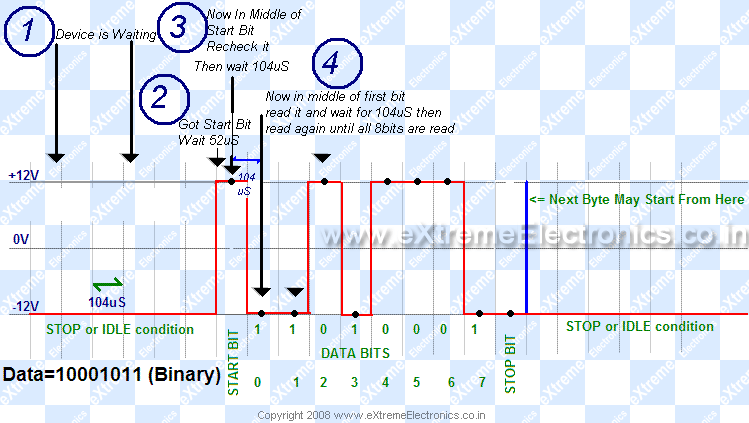
For our example for discussion of protocol we chose the speed as 9600bps(bits per second). As we are sending 9600 bits per second one bits takes 1/9600 seconds or 0.000104 sec or 104 uS (microsecond= 10^-6 sec).
To transmit a single byte we need to extra bits they are START BIT AND STOP BIT.Thus to send a byte a total of ten bits are required so we are sending 960 bytes per second.
Transmission
  1. When there is no transmission the TX line sits HIGH ( STOP CONDITION )
  2. When the device needs to send data it pulls the TX line low for 104uS (This is the start bit which is always 0)
  3. It sends each bit with duration = 104uS
  4. Finally it sets TX lines to HIGH for at least 104uS (This is stop bits and is always 1). "At least" because after you send the stop bit you can either start new transmission by sending a start bit or you let the TX line remain HIGH till next transmission begin in this case the last bit is more than 104uS.
rs232 transmission and reception  basics
Reception
  1. The receiving device is waiting for the start bit i.e. the RX line to go LOW.
  2. When it gets start bit it waits for half bit time i.e. 104/2 = 51uS now it is in middle of start bit it reads it again to make sure it is a valid start bit not a spike.
  3. Then it waits for 104uS and now it is in middle of first bit it now reads the value of RX line.
  4. In same way it reads all 8 bits
  5. Now the receiver has the data.
rs232 transmission and reception  basics
Level Conversion:
What a level converter will do is to convert RS232 level signals (HIGH=-12V LOW=+12V) from PC to TTL level signal (HIGH=+5V LOW=0V) to be fed to MCU and also the opposite.

As RS232 is such a common protocol there is a dedicated IC designed for this purpose of "Level Conversion". This IC is MAX232 from Maxim. By using charge pumps it generates high voltages(12V) and negative voltages(-12V).

rs232 level convertor using max 232 schematic

USART of AVR Microcontrollers:

Like many microcontrollers AVR also has a dedicated hardware for serial communication this part is called the USART – Universal Synchronous Asynchronous Receiver Transmitter.You just have to supply the data you need to transmit and it will do the rest. As you saw serial communication occurs at standard speeds of 9600,19200 bps etc and this speeds are slow compared to the AVR CPUs speed. The advantage of hardware USART is that you just need to write the data to one of the registers of USART and your done, you are free to do other things while USART is transmitting the byte.
USART automatically senses the start of transmission of RX line and then inputs the whole byte and when it has the byte it informs you(CPU) to read that data from one of its registers.
The USART of the AVR is connected to the CPU by the following six registers.
  • UDR – USART Data Register : Actually this is not one but two register but when you read it you will get the data stored in receive buffer and when you write data to it goes into the transmitters buffer.
  • UCSRA – USART Control and status Register A : As the name suggests it is used to configure the USART and it also stores some status about the USART. There are two more of this kind the UCSRB and UCSRC.
  • UBRRH and UBRRH : This is the USART Baud rate register, it is 16BIT wide so UBRRH is the High Byte and UBRRL is Low byte. But as we are using C language it is directly available as UBRR and compiler manages the 16BIT access.
So the connection of AVR and its internal USART can be visualized as follows.
AVR USART Registers
Before using the USART it must be initialized properly according to need. Having the knowledge of RS232 communication and Internal USART of AVR you can do that easily. We will create a function that will initialize the USART for us. 

#include <avr/io.h>
#include <inttypes.h>

void USARTInit(uint16_t ubrr_value)
{

   //Set Baud rate
   UBRR= ubrr_value;

   /*Set Frame Format

   
   >> Asynchronous mode
   >> No Parity
   >> 1 StopBit
   >> char size 8

   */

   UCSRC=(1<<URSEL)|(3<<UCSZ0);


   //Enable The receiver and transmitter
   UCSRB=(1<<RXEN)|(1<<TXEN);


}
After this procedure is done, we can send and receive data from the microcontroller via RS232 protocol.

Question Prefences

Sanket Joshi - Block Diagram of AM transmitter and receiver with explanation
Amit Tiwari - Case study, implementation and examples of MODBUS
Abhishek Tavaskar - Block diagram of FM transmitter and receiver and its explanation
Vishal Kele - Case study, implementation and examples of HART
Vishwajeet Patil - Different types of cables and its applications with diagrams
Hemant Jagtap - Case study, implemetation and examples of ZigBee
Satyavrat Wagle - RS232 circuit and interfacing with Microcontroller

NOTE : This list will be updated as and when students post their question preferences. Questions will be allocated on a First Come First Serve basis.

Block diagram of AM transmitter and receiver with explanation

Block diagram of AM transmitter and receiver with explanation
AM Transmitter :
Transmitters that transmit AM signals are known as AM transmitters. These transmitters are used in medium wave (MW) and short wave (SW) frequency bands for AM broadcast. The MW band has frequencies between 550 KHz and 1650 KHz, and the SW band has frequencies ranging from 3 MHz to 30 MHz. The two types of AM transmitters that are used based on their transmitting powers are:
·         High Level
·         Low Level
High level transmitters use high level modulation, and low level transmitters use low level modulation. The choice between the two modulation schemes depends on the transmitting power of the AM transmitter. In broadcast transmitters, where the transmitting power may be of the order of kilowatts, high level modulation is employed. In low power transmitters, where only a few watts of transmitting power are required , low level modulation is used.
High-Level and Low-Level Transmitters                                                                                       
Below figure's show the block diagram of high-level and low-level transmitters. The basic difference between the two transmitters is the power amplification of the carrier and modulating signals.
Figure (a) shows the block diagram of high-level AM transmitter.


 In high-level transmission, the powers of the carrier and modulating signals are amplified before applying them to the modulator stage, as shown in figure (a). In low-level modulation, the powers of the two input signals of the modulator stage are not amplified. The required transmitting power is obtained from the last stage of the transmitter, the class C power amplifier.
The various sections of the figure (a) are:
·         Carrier oscillator
·         Buffer amplifier
·         Frequency multiplier
·         Power amplifier
·         Audio chain
·         Modulated class C power amplifier
Carrier oscillator
The carrier oscillator generates the carrier signal, which lies in the RF range. The frequency of the carrier is always very high. Because it is very difficult to generate high frequencies with good frequency stability, the carrier oscillator generates a sub multiple with the required carrier frequency. This sub multiple frequency is multiplied by the frequency multiplier stage to get the required carrier frequency. Further, a crystal oscillator can be used in this stage to generate a low frequency carrier with the best frequency stability. The frequency multiplier stage then increases the frequency of the carrier to its required value.
Buffer Amplifier                                                
The purpose of the buffer amplifier is two fold. It first matches the output impedance of the carrier oscillator with the input impedance of the frequency multiplier, the next stage of the carrier oscillator. It then isolates the carrier oscillator and frequency multiplier.
This is required so that the multiplier does not draw a large current from the carrier oscillator. If this occurs, the frequency of the carrier oscillator will not remain stable.
Frequency Multiplier                                                
The sub-multiple frequency of the carrier signal, generated by the carrier oscillator , is now applied to the frequency multiplier through the buffer amplifier. This stage is also known as harmonic generator. The frequency multiplier generates higher harmonics of carrier oscillator frequency. The frequency multiplier is a tuned circuit that can be tuned to the requisite carrier frequency that is to be transmitted.

Power Amplifier
The power of the carrier signal is then amplified in the power amplifier stage. This is the basic requirement of a high-level transmitter. A class C power amplifier gives high power current pulses of the carrier signal at its output.
Audio Chain
The audio signal to be transmitted is obtained from the microphone, as shown in figure (a). The audio driver amplifier amplifies the voltage of this signal. This amplification is necessary to drive the audio power amplifier. Next, a class A or a class B power amplifier amplifies the power of the audio signal.
Modulated Class C Amplifier                                                             
This is the output stage of the transmitter. The modulating audio signal and the carrier signal, after power amplification, are applied to this modulating stage. The modulation takes place at this stage. The class C amplifier also amplifies the power of the AM signal to the reacquired transmitting power. This signal is finally passed to the antenna., which radiates the signal into space of transmission.
Figure  shows the block diagram of a low-level AM transmitter.

The low-level AM transmitter shown in the figure (b) is similar to a high-level transmitter, except that the powers of the carrier and audio signals are not amplified. These two signals are directly applied to the modulated class C power amplifier.
Modulation takes place at the stage, and the power of the modulated signal is amplified to the required transmitting power level. The transmitting antenna then transmits the signal.


AM Receiver :

The basic block diagram of a basic superhet receiver is shown below. This details the most basic form of the receiver and serves to illustrate the basic blocks and their function.

Block diagram of a basic superheterodyne radio receiver
The way in which the receiver works can be seen by following the signal as is passes through the receiver.

  • Front end amplifier and tuning block:   Signals enter the front end circuitry from the antenna. This circuit block performs two main functions:
    • Tuning:   Broadband tuning is applied to the RF stage. The purpose of this is to reject the signals on the image frequency and accept those on the wanted frequency. It must also be able to track the local oscillator so that as the receiver is tuned, so the RF tuning remains on the required frequency. Typically the selectivity provided at this stage is not high. Its main purpose is to reject signals on the image frequency which is at a frequency equal to twice that of the IF away from the wanted frequency. As the tuning within this block provides all the rejection for the image response, it must be at a sufficiently sharp to reduce the image to an acceptable level. However the RF tuning may also help in preventing strong off-channel signals from entering the receiver and overloading elements of the receiver, in particular the mixer or possibly even the RF amplifier.
    • Amplification:   In terms of amplification, the level is carefully chosen so that it does not overload the mixer when strong signals are present, but enables the signals to be amplified sufficiently to ensure a good signal to noise ratio is achieved. The amplifier must also be a low noise design. Any noise introduced in this block will be amplified later in the receiver.
  • Mixer / frequency translator block:   The tuned and amplified signal then enters one port of the mixer. The local oscillator signal enters the other port. The performance of the mixer is crucial to many elements of the overall receiver performance. It should eb as linear as possible. If not, then spurious signals will be generated and these may appear as 'phantom' received signals.
  • Local oscillator:   The local oscillator may consist of a variable frequency oscillator that can be tuned by altering the setting on a variable capacitor. Alternatively it may be a frequency synthesizer that will enable greater levels of stability and setting accuracy.
  • Intermediate frequency amplifier, IF block :   Once the signals leave the mixer they enter the IF stages. These stages contain most of the amplification in the receiver as well as the filtering that enables signals on one frequency to be separated from those on the next. Filters may consist simply of LC tuned transformers providing inter-stage coupling, or they may be much higher performance ceramic or even crystal filters, dependent upon what is required.
  • Detector / demodulator stage:   Once the signals have passed through the IF stages of the superheterodyne receiver, they need to be demodulated. Different demodulators are required for different types of transmission, and as a result some receivers may have a variety of demodulators that can be switched in to accommodate the different types of transmission that are to be encountered. Different demodulators used may include:


    • AM diode detector:   This is the most basic form of detector and this circuit block would simple consist of a diode and possibly a small capacitor to remove any remaining RF. The detector is cheap and its performance is adequate, requiring a sufficient voltage to overcome the diode forward drop. It is also not particularly linear, and finally it is subject to the effects of selective fading that can be apparent, especially on the HF bands.
    • Synchronous AM detector:   This form of AM detector block is used in where improved performance is needed. It mixes the incoming AM signal with another on the same frequency as the carrier. This second signal can be developed by passing the whole signal through a squaring amplifier. The advantages of the synchronous AM detector are that it provides a far more linear demodulation performance and it is far less subject to the problems of selective fading.
    • SSB product detector:   The SSB product detector block consists of a mixer and a local oscillator, often termed a beat frequency oscillator, BFO or carrier insertion oscillator, CIO. This form of detector is used for Morse code transmissions where the BFO is used to create an audible tone in line with the on-off keying of the transmitted carrier. Without this the carrier without modulation is difficult to detect. For SSB, the CIO re-inserts the carrier to make the modulation comprehensible.
    • Basic FM detector:   As an FM signal carries no amplitude variations a demodulator block that senses frequency variations is required. It should also be insensitive to amplitude variations as these could add extra noise. Simple FM detectors such as the Foster Seeley or ratio detectors can be made from discrete components although they do require the use of transformers.
    • PLL FM detector:   A phase locked loop can be used to make a very good FM demodulator. The incoming FM signal can be fed into the reference input, and the VCO drive voltage used to provide the detected audio output.
    • Quadrature FM detector:   This form of FM detector block is widely used within ICs. IT is simple to implement and provides a good linear output.
  • Audio amplifier:   The output from the demodulator is the recovered audio. This is passed into the audio stages where they are amplified and presented to the headphones or loudspeaker

Monday, 6 April 2015

Communication Protocols Assignment Questions


  1. Block diagram of AM transmitter and receiver and its explanation
  2. Generation of AM wave
  3. Detection of AM wave
  4. Block diagram of FM transmitter and receiver and its explanation.
  5. Generation of FM wave
  6. Detection of FM wave
  7. Power amplifier type A,B,C type with circuit design, features and applications
  8. Maximum power transmission theorem and verification
  9. RS232 circuit and interfacing with microcontroller
  10. RS485 circuit and interfacing with microcontroller
  11. Different types of cables and its applications with diagrams
  12. Wired and wireless communication channels with respective bandwidth and applications
  13. Electrical noise and interference
  14. Data error detection and correction techniques
  15. Orthogonal Frequency Division Multiplexing (OFDM)
  16. Case study, implemetation and examples of I2C
  17. Case study, implemetation and examples of SPI
  18. Case study, implemetation and examples of CAN
  19. Case study, implemetation and examples of MODBUS
  20. Case study, implemetation and examples of Bluetooth
  21. Case study, implemetation and examples of ZigBee
  22. Case study, implemetation and examples of IRDA
  23. Case study, implemetation and examples of WiFi
  24. Case study, implemetation and examples of WiMax
  25. Case study, implemetation and examples of ProphyBus
  26. Case study, implemetation and examples of HART
  27. Case study, implemetation and examples of FieldBus
  28. Troubleshooting and selection of Modem
  29. Troubleshooting and selection of Ethernet
  30. Troubleshooting and selection of HART, ProphyBus, FieldBus